How long is a skydive? From 4,000 m (13,000 ft), expect about 50 seconds of freefall at close to 200 km/h (125 mph), followed by 5 to 7 minutes under the parachute after it opens at around 1,500 m (5,000 ft). From leaving the aircraft to landing, the skydive itself lasts 6 to 8 minutes. Including the climb, your time in the air is under half an hour – and the whole experience gives you half a day of pure joy. Here are all the numbers, explained simply, so you know exactly what is in store.
How long is a skydive? The quick answer
A skydive from 4,000 m lasts 6 to 8 minutes from exit to landing: about 50 seconds of freefall at close to 200 km/h, then 5 to 7 minutes under canopy after the parachute opens at around 1,500 m. Add the 15 to 20 minute climb and you spend about 25 minutes in the air: plenty of time to savour every moment, from the first thrill at the door to a soft touchdown.
Skydiving from 4,000 m (13,000 ft): the key numbers
- Climb to altitude: 15 to 20 minutes
- Freefall: about 50 seconds
- Freefall speed: about 200 km/h (125 mph)
- Parachute opening: at around 1,500 m (5,000 ft)
- Canopy ride: 5 to 7 minutes
- Take-off to landing: about 25 minutes
- Time to allow at the dropzone: half a day
These are the figures for a tandem skydive at PACMA in Beni Mellal, Morocco. They're close to those of most centres that jump from 4,000 m. Curious to compare? Try other altitudes with the freefall calculator further down.
The whole experience vs the skydive itself
A skydive lasts 6 to 8 minutes from exit to landing, of which roughly 50 seconds is freefall. But the full experience – welcome, briefing, kitting up, waiting for your turn and the climb – usually takes up half a day at the dropzone: a real day of adventure, with the excitement building at every step.
Four different durations often get mixed up:
| What you're measuring | Typical duration |
|---|---|
| Freefall only | About 50 s from 4,000 m |
| The skydive (exit → landing) | 6 to 8 min |
| The whole flight (take-off → landing) | About 25 min |
| Your time at the dropzone | Half a day, sometimes more depending on the weather |
Why the big gap between the jump and the day? Because several steps, all part of the fun, come before boarding: paperwork, a ground briefing, harness fitting, then waiting for your lift, which depends on how many people are jumping and on the weather. The full sequence is described in our article how does tandem skydiving work?.
The climb to altitude
The climb to 4,000 m takes 15 to 20 minutes in a jump aircraft such as the Pilatus PC-6 Porter. It's the longest phase of the flight, and one of the most beautiful, as the view widens by the minute. Your instructor uses it to check the equipment and attach you to their harness.
How long the climb takes depends on three things:
- The aircraft. A turbine jump plane climbs far faster than a small piston single. The Pilatus PC-6 Porter used at PACMA is a short take-off aircraft carrying nine skydivers plus the pilot. Its story is told in our article on the Pilatus PC-6 Porter.
- The target altitude. The last few hundred metres are the slowest, because thinner air reduces engine and wing performance.
- Load and temperature. A full aircraft on a hot day climbs more slowly. In winter, cool, dense air helps.
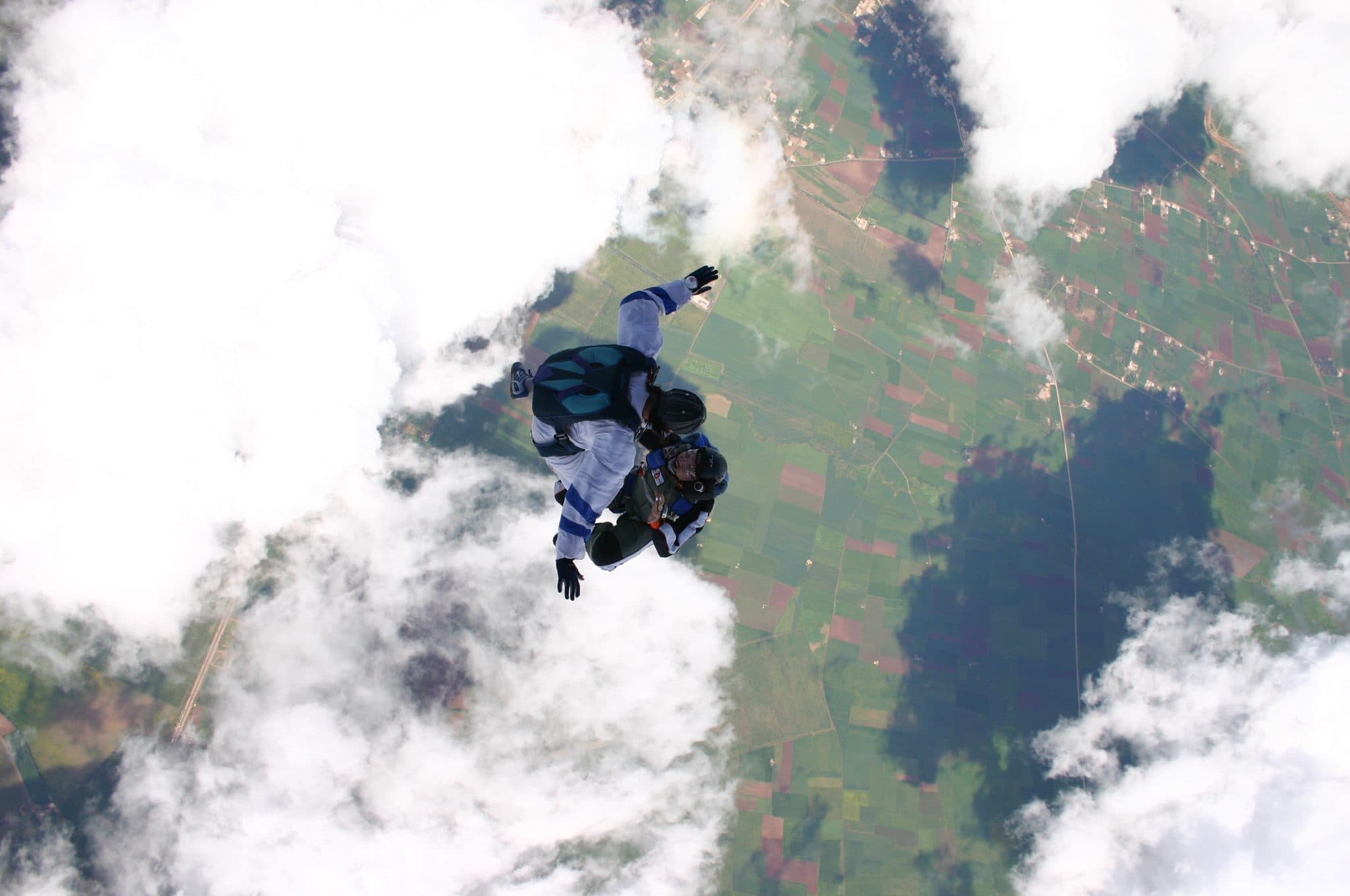
In Beni Mellal, the aircraft climbs in wide circles over the Tadla plain, facing the Middle Atlas: a spectacular panorama before you have even jumped.
How long is freefall? About 50 seconds from 4,000 m
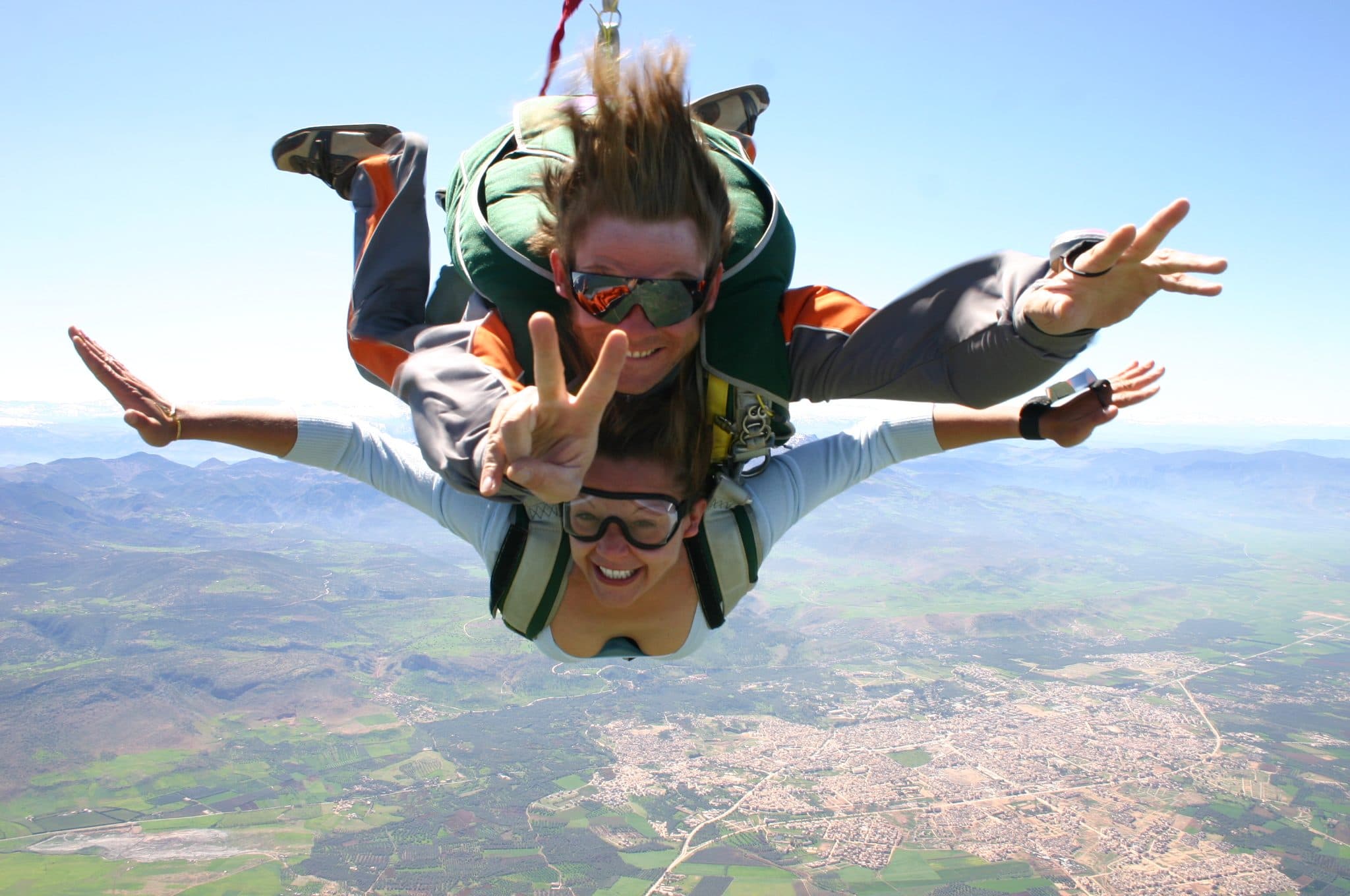
From 4,000 m, freefall lasts around 50 seconds until the parachute opens at about 1,500 m. That means falling roughly 2,500 m (8,000 ft). The first ten seconds or so are spent accelerating; after that, your speed settles at about 200 km/h until opening: 50 seconds of pure adrenaline, with the Atlas on the horizon.
The maths, step by step
- Acceleration. As you leave the aircraft, your vertical speed is close to zero. It builds quickly for about ten seconds, until air resistance balances your weight. You cover roughly 300 to 400 m in this phase.
- Terminal velocity. You then fall at a steady speed of about 55 m/s – close to 200 km/h. That leaves about 2,100 m to the opening altitude, or roughly 40 seconds.
- Total: 10 + 40 = about 50 seconds.
The United States Parachute Association (USPA) gives a general range of 30 to 60 seconds of freefall for a tandem or first jump, depending on exit altitude (USPA FAQs).
On a tandem, freefall lasts just as long as it does solo. Right after exit, the instructor deploys a small stabilising parachute called a drogue, which keeps the pair at roughly the speed of a single skydiver.
Those 50 seconds fly by, and stay with you for a long time. What it actually feels like – the wind, the noise, breathing – is described in our article what does skydiving feel like?.
Skydiving speed: terminal velocity, and why freeflyers fall faster
Falling flat and belly-to-earth, you race along at about 200 km/h (125 mph) after roughly ten seconds: that's terminal velocity, and it's exhilarating. In head-down or upright positions – known as freeflying – speeds regularly exceed 250 km/h (155 mph), because the body presents less surface to the airflow.
What is terminal velocity in skydiving?
As you fall, two forces act on you: your weight, pulling you down, and air resistance, which increases with speed. After about ten seconds, they balance out and you stop accelerating. That steady speed is terminal velocity. The USPA puts it at about 120 mph for a typical skydive – roughly 193 km/h.
What changes your speed
| Body position or phase | Approximate speed |
|---|---|
| Flat, belly-to-earth (tandem, students, formation skydiving) | About 200 km/h (125 mph) |
| Sitting or standing (freefly) | About 230–270 km/h (145–170 mph) |
| Head-down (freefly) | Often 250–300 km/h (155–185 mph) |
| Under canopy, after opening | A few metres per second vertically |
Several factors affect terminal velocity:
- Body position: the less surface you expose to the wind, the faster you fall.
- Weight and build: for the same surface area, a heavier skydiver falls slightly faster. Skydivers compensate with body position or with tighter or baggier jumpsuits.
- Altitude: the air is thinner higher up, so you fall a little faster there than near the ground.
Parachute opening at around 1,500 m, and the canopy ride
On a tandem, the parachute opens at around 1,500 m (5,000 ft). Deployment takes a few seconds and slows you from 200 km/h to a gentle descent. The canopy ride then lasts 5 to 7 minutes until landing, depending on wind and manoeuvres: total calm after the intensity, with a breathtaking view.
Why 1,500 m?
The opening altitude leaves a comfortable safety margin. If there were a problem with the main parachute, the instructor would have all the time needed to use the reserve. In the French AFF progression (known as PAC), the French Parachuting Federation (FFP) requires students to open at 1,500 m or higher. How the opening actually works is explained in how does a parachute work?.
How long under canopy?
From 1,500 m, allow 5 to 7 minutes. It varies with:
- manoeuvres: a spiral burns off height very quickly, while flying straight preserves it;
- wind: flying into a headwind, the canopy makes slow progress towards the landing area;
- canopy size and suspended weight.
These are often the most contemplative minutes of the jump – the time to savour the view over the plain and the peaks of the Atlas, and to realise what you have just done.
What altitude do you skydive from? 3,000 m vs 4,000 m vs 4,500 m+
How high do you skydive? Most centres drop tandems from between 3,000 and 4,500 m (10,000–15,000 ft), and the parachute opens at around 1,500 m. Every extra 1,000 m adds about 18 to 20 seconds of freefall: about 30 s from 3,000 m, 50 s from 4,000 m and 60 s from 4,500 m.
| Exit altitude | Freefall to 1,500 m | Good to know |
|---|---|---|
| 3,000 m (10,000 ft) | About 30 s | Shorter climb, around 20 s less freefall |
| 3,500 m (11,500 ft) | About 40 s | Common altitude for student (AFF) jumps |
| 4,000 m (13,000 ft) | About 50 s | Standard at many centres, including PACMA |
| 4,500 m (15,000 ft) | About 60 s | Longer climb, colder air |
| Above 5,000 m (16,500 ft) | Over a minute | Special jumps; oxygen needed on board |
These are ballpark figures for a belly-to-earth jump; a faster freefly jump cuts a few seconds off the freefall.
Work out your own freefall time
Enter an exit altitude, in metres or feet, and an opening altitude: the calculator uses the same physical model as this table (terminal velocity of about 200 km/h, reached in roughly ten seconds). Handy for comparing two centres, or for seeing what a "15,000 ft" offer is really worth.