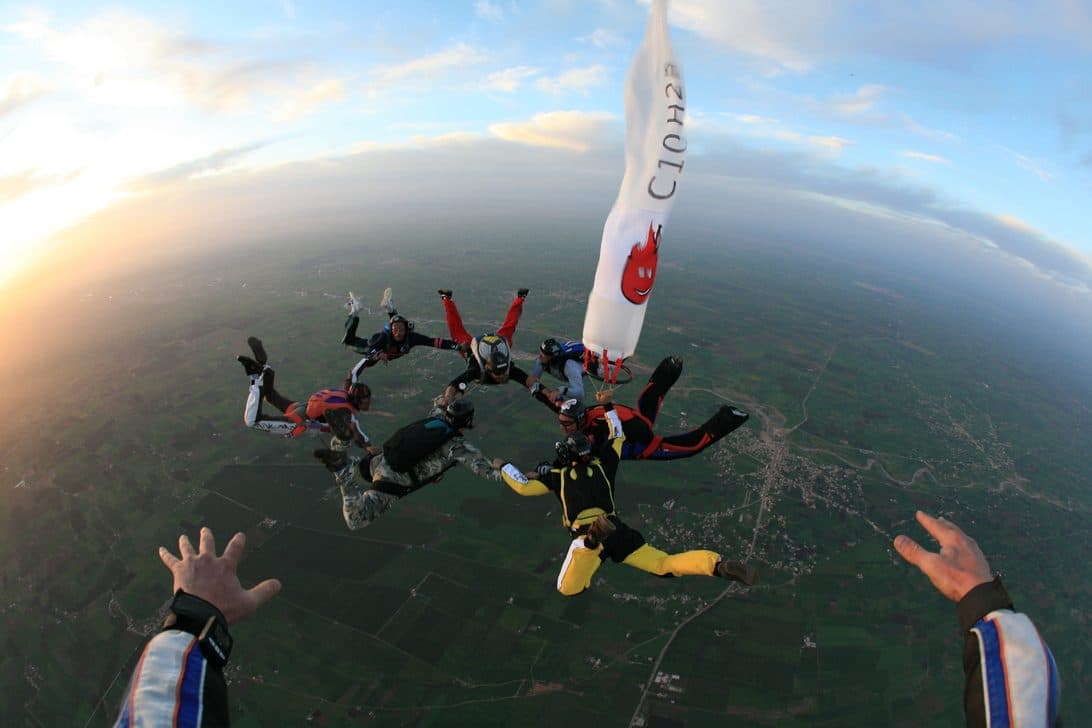
Your home dropzone closes at the end of October and you have no intention of waiting until April to get back in the air? A winter dropzone in the sun is the answer, and winter becomes your best jumping season: southern Spain, Morocco, Dubai and the United States all let you jump right through the winter. In Beni Mellal, for example, the season runs from 5 December 2026 to 4 April 2027, from a Pilatus PC-6 at 4,000 m, for €27 a jump. This guide, written for licensed skydivers, compares winter dropzones on what really matters: when your home DZ closes, aircraft and turnaround, altitude, ticket prices, gear hire, logistics and the cost of a typical week.
Why go skydiving in winter
The reasons are often the same among the skydivers we welcome each season, and they are all excellent.
- Staying current. Four or five months without a jump is a long time. Emergency drills, altitude awareness and canopy skills all get rusty, and coming back in April after a long layoff often means a check jump or refresher training. We cover the rules and good habits in getting back into skydiving after a break.
- Progressing. Winter is the perfect time to rack up jumps, work towards your next licence or train a discipline with a coach. Without the weekend weather lottery, you can sometimes log more jumps in one week in the sun than in two months of summer at home.
- Preparing for the season. Formation skydiving and freefly teams use the winter to train and arrive ready in spring. For an overview of the different styles, see our guide to skydiving disciplines.
- Pure enjoyment. Flying your canopy in a T-shirt in January, over a landscape you've never seen and facing snowy peaks, is a wonderful way to break up the winter.
When do UK and European dropzones close? Month by month
Many northern European dropzones jump from April to October, then close or only fly on the odd Saturday when the forecast allows. For a licensed jumper, that means four to five months grounded, from November to March. The good news: southern Spain flies all year round, and the Beni Mellal season (5 December to 4 April) covers exactly that gap, every day.
Here is the calendar published by a few representative dropzones, month by month (checked on 18 October 2026 on their own website or the local tourist board's).
| Dropzone | Oct | Nov | Dec | Jan | Feb | Mar | Apr |
|---|---|---|---|---|---|---|---|
| GoSkydive, Old Sarum (UK) | ✓ | ✓ | – | – | ✓ restart | ✓ | ✓ |
| Paracentrum Texel (Netherlands) | ✓ | ◐ | ◐ | ◐ | ◐ | ◐ | ✓ |
| Take Off, Fehrbellin (Germany) | ✓ | – | – | – | – | – | ✓ |
| Royan-Médis (France) | ✓ to 30th | – | – | – | – | – | ✓ from 4th |
| Skydive Spain, Seville (Spain) | ✓ | ✓ | ✓ | ✓ | ✓ | ✓ | ✓ |
| PACMA, Beni Mellal (Morocco) | – | – | ✓ from 5th | ✓ | ✓ | ✓ | ✓ to 4th |
✓ open; ◐ partly open; – closed. Sources: GoSkydive, closed in December and January, season restarting in February; Paracentrum Texel, closed on weekdays in winter and open on Saturdays only when Friday's forecast is good enough; Take Off's April-to-October season according to top10berlin; the 2026 season of Royan Océan Parachutisme (4 April to 30 October); Skydive Spain, which presents itself as open all year.
These examples show a trend, not a rule: your own dropzone may fly more, or less, so check its calendar. If it goes quiet in November, you can book your jump tickets for Beni Mellal for any day between 5 December and 4 April.
How to choose your winter dropzone
Choosing where to fun jump is very different from choosing a tandem. Here is the checklist we recommend to find the DZ that will keep you jumping.
| Criterion | What to look at | Question to ask the DZ |
|---|---|---|
| Aircraft and turnaround | Aircraft type, seats, number of planes | How many loads a day on average? |
| Altitude | Standard exit height | Are high jumps the same price? |
| Ticket price | Single tickets, jump blocks | Do tickets expire? |
| Gear hire and packing | Price per jump, deposit | Does hire include packing? |
| Requirements | Minimum jumps, licence, insurance | Will my paperwork be accepted as it is? |
| Tandem priority | Share of commercial activity | Are fun jumpers guaranteed slots? |
| Logistics | Airport, transport, accommodation | Is there accommodation near the runway? |
| Vibe and organisers | Community, coaches, events | Are coaches or camps planned? |
That last point is often underrated. A dropzone built around tandems can fill its loads with customers and leave few slots for fun jumpers. A sport-focused DZ, on the other hand, flies jumper loads all day. If you are travelling for an event, read our guide to skydiving boogies too.
Winter dropzones at a glance: fact sheets
The information below comes from each dropzone's official website, checked in October 2026. Prices are public prices on that date, given in each centre's own currency, and may change.
Southern Spain: Seville
Skydive Spain, near Seville, is presented as a dropzone built for experienced skydivers that flies every day of the year. Tickets are €39.75, or €387.50 for a block of 10, and gear hire is €30 per jump including packing. Standard jumps expire after 12 months. Third-party liability insurance is sold on site from €106 for one month. The centre also runs events, including a "Xmas Boogie" at the end of the year. Weather-wise, Seville gets about 189 hours of sunshine in January and 16 °C in the afternoon (AEMET 1991–2020 normals).
Best for: jumpers who want volume, team training or coaching at a big European centre.
North-east Spain: Empuriabrava
The Costa Brava's historic centre, Skydive Empuriabrava, lists jumps at €42, a block of 25 at €966, gear hire at €27.95 per jump (packing included, deposit required) and pack jobs at €9.70. Medical and third-party insurance valid in Spain is compulsory, and the centre can sell you a policy (€119 for one month). Winters there are cooler than in Andalusia.
Best for: anyone wanting a full-service centre within driving distance of southern France.
Portugal: the Algarve
Good to know before you book: Skydive Algarve in Portimão only hosts skydivers with at least 1,000 jumps, because of the limits of its landing area, and its operation is mainly tandem-focused. Tickets are €39. The centre itself points other licensed jumpers to Skydive Spain, about 2.5 hours away by road.
Best for: very experienced jumpers wintering in the Algarve.
Morocco: Beni Mellal
PACMA, a club approved by the French Parachuting Federation (FFP) and founded in 2000, has jumped at Beni Mellal airport since 2003, in partnership with Vertical T'Air from Arcachon, France. Pilatus PC-6, 4,000 m, €27 a jump for non-residents, open every day of the season. Full details in the close-up below.
Best for: jumpers looking for winter sun a few hours' flight from Europe, a plane to 4,000 m, a friendly atmosphere and a budget that stays under control.
United Arab Emirates: Dubai
Skydive Dubai welcomes licensed skydivers at its Desert Campus: AED 150 a jump, gear hire with packing AED 110, check jump AED 550. Things to know before you go:
- the Palm dropzone requires a USPA D licence or FAI equivalent, and slots there are not guaranteed because of the volume of tandems;
- currency rules are specific: for example, at least one jump in the last 60 days if you have between 25 and 49 jumps;
- reserve repacks are only valid for 180 days there, whatever country issued your licence;
- an AAD is compulsory (Cypres, Vigil or M2; Argus not accepted).
Best for: combining a Dubai trip with a few jumps, or chasing a Palm jump with the right licence.
United States: Arizona, Florida, California
In winter, American skydivers head south: Arizona (Eloy), Florida (DeLand, Sebastian) and southern California (Perris). These are world-class centres with large fleets and training camps. For a European, factor in the airfare and the US rule of a reserve repack every 180 days. Check each dropzone's website for prices and calendars.
Best for: teams and jumpers who want an intensive camp and don't mind a long trip.
Southern hemisphere
Australia, New Zealand, South Africa: it's summer from December to February. Conditions are excellent, but the journey and jet lag make it an option mainly for those already planning a long-haul trip.
Close-up on Beni Mellal: season, Pilatus PC-6, 4,000 m, €27 a jump
Here, in practical terms, is what's waiting for you with us.
The season. From 5 December 2026 to 4 April 2027, every day from 8:30 am to 6 pm. Online ticket booking is open until 4 April 2027.
The aircraft. The Pilatus PC-6 Porter carries 9 skydivers plus the pilot. One Pilatus flies all season, and a second joins at busy periods. The climb to 4,000 m takes 15 to 20 minutes, for about 50 seconds of freefall. Why is this little plane a legend of the sport? We've written a whole article about it: the Pilatus PC-6 Porter.
Ticket and gear hire prices.
| Item | Non-residents | Moroccan residents |
|---|---|---|
| Jump from 4,000 m | €27 | 290 MAD |
| Jump + gear hire | €37 | 400 MAD |
| Jump + gear hire + packing | €42 | 450 MAD |
| Field card (DZ access) | €20 | 100 MAD |
All our prices and the field card conditions are on the licensed skydivers page.
Requirements. A valid licence or certificate and insurance, your logbook, an in-date reserve repack and a serviced AAD. The chief instructor may ask for a check jump. PACMA is a club approved by the French Parachuting Federation (FFP): instruction and rules of practice are those of the FFP, and every parachute is fitted with an AAD.
The vibe. Many French skydivers and instructors spend the winter in Beni Mellal, particularly around the Vertical T'Air crew from Arcachon. At the busiest times, the second Pilatus steps in. The Tadla plain offers wide open areas around the runway, and the view of the snow-capped Middle Atlas, on every jump, is part of the trip. At lunchtime, a buffet is served under the traditional caidal tent by the runway.
Getting here. 2 hours by road from Casablanca airport, 2.5 hours from Marrakech.
Your first day with us, step by step
- Check-in and paperwork. Bring your licence or certificate, insurance, logbook and reserve data card. Our instructors also check your AAD dates.
- Gear check. If you bring your own rig, it is inspected before your first jump. If you hire, you get a canopy suited to your experience and wing loading.
- DZ briefing. Landing area, landing pattern, outs and obstacles around the runway, off-landing procedures: nobody jumps an unfamiliar dropzone without this briefing.
- Check jump if needed. The chief instructor may ask for one, for example after a long layoff or if your recent experience is light.
- Manifest and loads. With a 15 to 20 minute climb and 9 seats per Pilatus, sort out your jump groups in advance to fill the loads efficiently.
Our instructors' tip. Keep your first jumps of the trip simple: solo or a two-way, a high pull, a careful pattern. The terrain, the light and the visual references of the Tadla are new to you. Group jumps can start from day two.
How much does a week of winter jumping cost?
For 20 jumps in a week on your own gear, allow €540 in Beni Mellal (plus a €20 field card), against roughly €775 to €840 in Seville or Empuriabrava, and AED 3,000 in Dubai, based on public prices in October 2026. On hired gear the gap widens: €840 including packing with us, against roughly €1,375 to €1,400 in Spain, and AED 5,200 in Dubai. That means more jumps for the same budget.
| Dropzone | 20 jumps, own gear | 20 jumps, hired gear | Source |
|---|---|---|---|
| Beni Mellal (PACMA) | €540 (+ €20 field card) | €840 with packing | PACMA 2026–27 prices |
| Seville (Skydive Spain) | €775 (2 blocks of 10) | ~€1,375 with packing | Skydive Spain |
| Empuriabrava | €840 (20 × €42) | ~€1,400 (+ deposit) | Skydive Empuriabrava |
| Dubai, Desert Campus | AED 3,000 | AED 5,200 | Skydive Dubai |
Then add the costs that depend on your situation:
- flights: vary widely by date and departure airport, possibly with a fee for your rig;
- accommodation: anything from a shared room near the runway to a hotel in town, easily a threefold difference;
- insurance: check before you leave, as some DZs sell it on site;
- local transport: hire car or shuttle to the runway;
- food: at our place, the lunch buffet under the tent is 70 MAD.
Our take: the total cost depends mostly on your flight and accommodation. But for a licensed jumper who jumps a lot, the difference comes down to volume: the more you jump, the more the ticket price matters. At €27 for a jump from 4,000 m, every extra load is an affordable pleasure. Ready to turn your winter into a jumping season? Book your tickets for Beni Mellal and add gear hire to your booking if you are travelling light.
Checklist before you go
- Licence and insurance: are they valid abroad? Check with your federation and your insurer. Everything is explained in jumping abroad: licence, insurance, logbook and reserve repack.
- Reserve: will the repack date last until the end of your trip? Rules differ by country (at least once a year in France, every 180 days in the US and Dubai).
- AAD: is it within its service life and up to date on maintenance? A CYPRES has a 12.5-year life (15.5 years for units made since 2017), a Vigil 20 years.
- Logbook: up to date and signed, including your recent jumps. Some DZs ask for the last twelve months.
- Currency: if your last jump was several months ago, plan for a check jump (see our article on getting back into the sport).
- Your rig on the plane: cabin or hold, AAD, security screening. Read our guide to flying with your parachute.
- Tickets: before buying a block, ask whether it expires (at Skydive Spain, for example, standard jumps are valid for 12 months), and book online to save time on arrival. With us: buy your jump tickets for Beni Mellal.